
Arkheron Tower Floors: Every Level and Landmark
All four Arkheron tower floors, the landmarks on each one, and what changes strategically as your squad climbs toward the Throne.
Arkheron's tower is four floors tall, and each floor is a full map with its own name, its own monster population and its own landmarks. Learning the names is not trivia — callouts are how a squad rotates without standing still to type, and half the fights in the tower are decided by who knows which door leads where.
The arkheron walkthrough→ follows a single climb through these rooms, in the order a squad actually reaches them.
Here is every floor, what distinguishes it, and what the map is quietly asking you to do.
Quick answer: Arkheron has four floors — the Sanctuary of Stone, the Archives, the Ancient, and the Throne of the Ancient at the summit. Each is gated behind beacon control, and the fourth is a single arena where the last two teams fight for the run.
Floor 1: Sanctuary of Stone
The opening floor is a burial city. It is the largest floor in terms of usable rooms and the one with the most low-threat monsters, which makes it the right place to learn chest routing without dying to a rival squad every thirty seconds.
Floor layout only matters inside a mode, and the arkheron game modes→ page explains how Ascension and Spires use the same tower differently.
Landmarks worth memorising:
- The Royal Crypt and the Tombs of Nobility are dense with chests and monsters, and usually quieter than the gate side of the map.
- The Mausoleum sits close to a bridge approach, so it hears traffic early.
- The Stone Yard is the open fight space. If a team wants to contest your opening, this is where it happens.
- The Bridge of the Seeker is the main route upward and the most predictable place in the game to get third-partied.
- The Gateway is the gate proper: a chokepoint, a defensible room and a bad place to arrive at half health.
- The City of Bells, the Silent Quarter and the Lightless Garden are the quieter outer ring — good for a squad that dropped late or lost its first fight.
- The Realm of Mahara, the Bunker and the Bloom are the deep rooms. More loot, more monsters, longer walk back to the gate.
The strategic lesson of floor one is economy: leave it with at least two completed two-piece bonuses, or you will spend floor two avoiding fights you cannot win.
Floor 2: The Archives
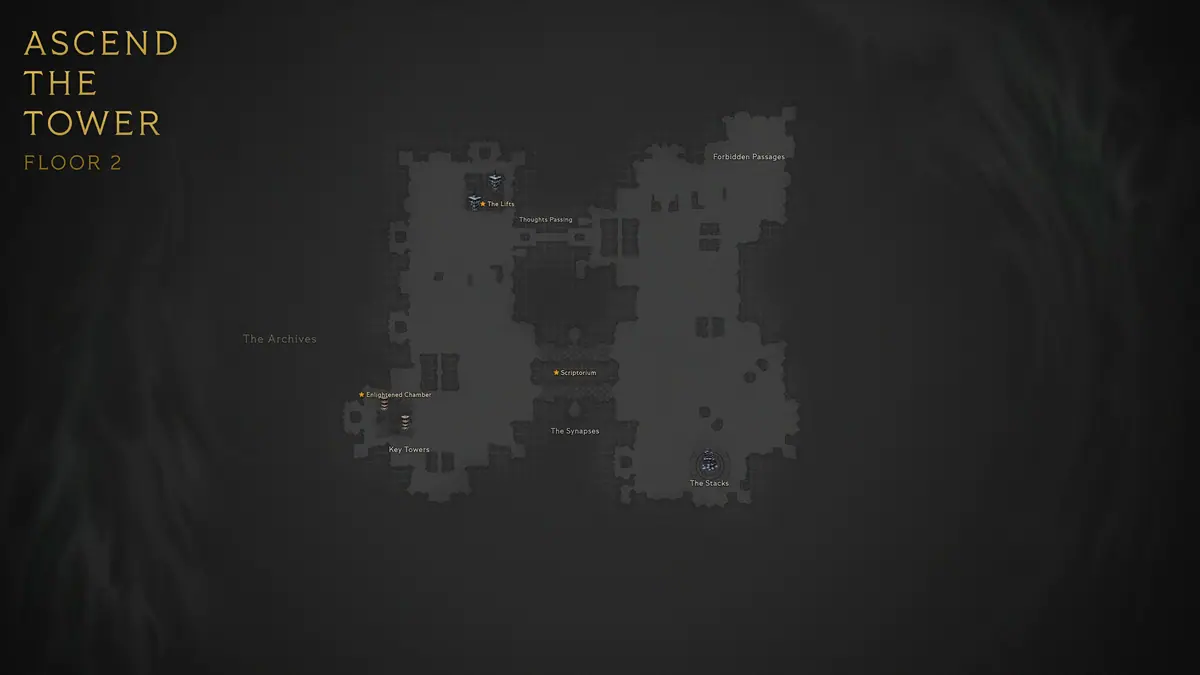
The Archives is vertical. The Lifts connect stacked rooms, the Synapses are narrow bridges between them, and the Key Towers give ranged players angles that the first floor never offers. Teams that only know how to hold a flat room get picked apart here.
- The Lifts are the fastest way to change elevation and the easiest way to walk into a crossfire. Take them when you control the room above, not when you are guessing.
- The Synapses are the floor's signature hazard: short bridges with a long fall. Crossing as a group is safer than crossing one at a time, because a single player on a bridge is the easiest execution in the game.
- The Scriptorium and the Enlightened Chamber are the loot-dense rooms. Expect company.
- Forbidden Passages and Thoughts Passing are the rotation lanes that let you avoid the Scriptorium altogether if you are behind.
Floor 3: The Ancient
The third floor is built around a dead god's arena. It is more open than the Archives and far more punishing, because by this point every surviving team has a transform and a full consumable bag.
- The Theatre of Blades is the central stage, and it is exactly as exposed as it sounds.
- The Arena Floor is the largest open space in the tower. Fights here are decided by cooldowns, not cover.
- Silver's Crossing and Cidric's Skyway are the routes between the arena and the outer rooms. They are fast and they are deadly when contested.
- The Mud Pit is the floor's reset button: a slowed, messy fight that rewards the team with better sustain.
- Aswran's Tree is the visual anchor of the floor and a common meeting point for teams that want a fight without committing to the arena.
The launch patch adjusted the beacon requirement on this floor, so the number of objectives you need is not fixed across patches. Check the tracker rather than relying on a beta memory.
Floor 4: Throne of the Ancient
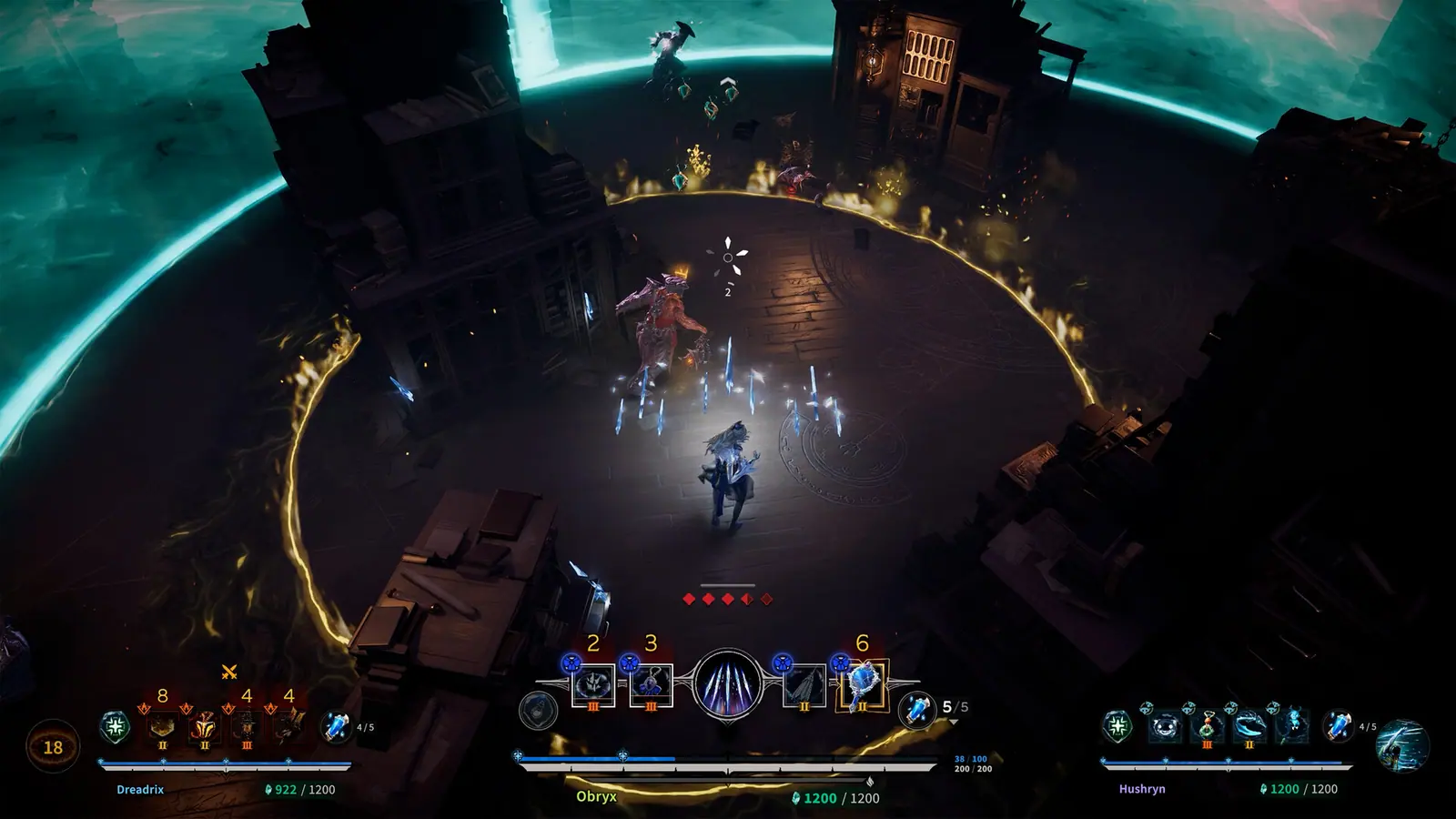
The summit is not a looting floor. It is one arena, two teams, and whatever you brought with you. There are no chests to fix a bad build and no monsters to hide behind. If you arrive with empty consumables, you arrive with a disadvantage you cannot solve.
The floor's only real decision is where to take the fight. Forcing the other team to cross open ground toward you is worth more than any individual outplay, and it is the reason teams that arrive first usually win.

How the floors connect
Every floor ends with a gate. Claiming the required beacons opens the route up, and the gate itself becomes a chokepoint that other teams can camp. Two rules follow from that:
- Never take a gate you have not scouted. Send one player to look, keep two on the beacon, and only commit when the route is clear or the clock forces you.
- Expect the floor above to be worse. Teams that arrive on a new floor are often still healing. The squad that camped the arrival side has a free first fight.
In the 30-player adaptive version of the map, the abyss becomes an immediate environmental hazard in some areas, shrinking the playable space. That does not change the floors, but it does make the outer rooms far less safe than they are in a full lobby.
Which floor is hardest?
Floor three, for most squads. Floor one is about economy, floor two is about positioning, and floor three is where the lobby is small enough that every fight is against a team that has already proven it can survive. The summit is simpler: one fight, all your resources, no excuses.
The four floors are the Sanctuary of Stone, the Archives, the Ancient and the Throne of the Ancient. The landmarks under each name are the rooms you will actually call out.
FAQ
How many floors does Arkheron have?
Four: the Sanctuary of Stone, the Archives, the Ancient and the Throne of the Ancient.
Do the floors change between matches?
The floor themes and landmarks are fixed, but drops, chest placement and objective locations vary. The launch build also uses a 30-player map variant with abyss hazards when queues are thin.
Can you go back down a floor?
No. Ascension is a climb, and the gate only opens upward. That is why leaving a floor with unspent Fragments is a waste.
Is the tower the same in Spires?
No. Spires is a 3v3 mode with ten floors of arenas and a shop between rounds; it does not use the Ascension tower map.
Official source: Arkheron Game Overview ↗ · Early Access 1.0 patch notes ↗ · Play Arkheron ↗